


Creativity is Social
Maximizing efficiencies is not enough for continued growth. Businesses must get creative.
Learn how to cultivate a culture that enhances creativity and increases the chances of creative ideas becoming innovations.
- Discover the top 15 skill sets that are in demand
- Learn how to enhance your creative abilities individually and as a team
- Explore how following the journey from creativity to innovation leads to better and more tangible results
- From individual idea generation
- To network-wide idea elaboration
- Idea championing in an organization
- And finally idea implementation
- Explore the 7 essential factors organizations must address to raise teams to the next level
.png)
What is the difference between creativity and innovation?
It’s important to understand the difference between creativity and innovation, as the terms are often used interchangeably.
Creativity is the generation of novel and useful ideas, often by connecting knowledge in new ways. Innovation is the realization of those ideas (as products, services, practices, etc.) and their implementation to create value.
"Creativity is just connecting things."
Steve Jobs
With the accelerated lifecycles of products and services, companies have to think about problems and business issues in new ways.
 (Small).png)
Focus on process vs individual talent to drive innovation.
Our ability to survive and thrive in diverse environments is due to our collective human creativity. Despite ongoing research, we now know that creativity is not just a function of the brain's "right side," but a potential shared by everyone. While most people see creative colleagues on their teams, creativity alone is not enough. Transforming those novel ideas into actual innovation requires the right supportive environment and a structured process. Research is continually finding new ways to enhance this universal human capacity.
In our survey, 82% of respondents said there are creative people on their own team, but creativity is the result of more than just individual traits and skills. It also depends on the situation or environment, and the transformation of creativity into innovation is the result of a process.
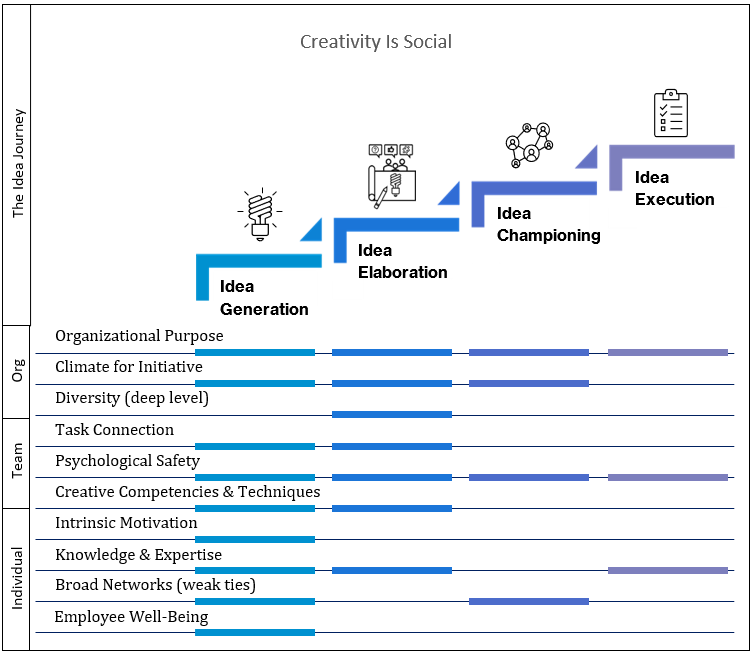
Organizations fail to actively solicit and support employee innovations.
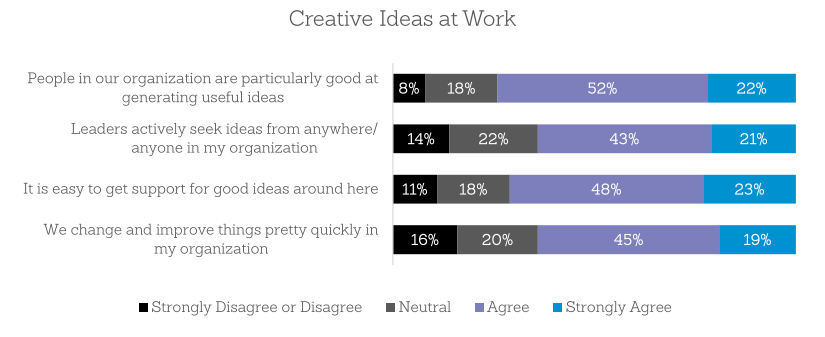
Unlike film studios, many organizations are not in the habit of seeking out and developing creative new ideas. While nearly three-quarters of the respondents in our study agreed that their colleagues are good at generating useful ideas, far fewer agreed that leaders actively seek ideas from anywhere and anyone in the organization.
Many good ideas seem destined for nowhere, with nearly 3 in 10 respondents unable to agree that it is easy to get support for them… Most respondents feel their organizations could do more to make the journey for creative ideas easier.

Leaders can cultivate psychological safety and purpose to unlock team creativity.
Team leaders are crucial for building a creative work environment. They do this by helping people connect their daily tasks to the company's overall mission. Leaders must also manage psychological safety, which makes employees comfortable sharing new ideas and engaging in the necessary, productive debates to develop those ideas further. While everyone has innate creativity, leaders can boost it by teaching basic creative techniques and protecting team members' intrinsic motivation by reducing stress and encouraging them to learn and expand their professional networks.


